Does Creatine Cause Hair Loss? What the Science Shows (2026)
Ask anyone who has hesitated before starting creatine and hair loss is usually somewhere on their list of concerns. The fear is understandable – creatine is one of the most discussed supplements online and the hair loss claim has been circulating for over a decade. But does creatine cause hair loss? The honest answer, based on the current body of evidence including a brand new 2025 randomized controlled trial that directly measured hair follicle health, is no. This article breaks down exactly where the concern came from, what the science actually shows, and what you need to know if you are worried about your hair.
Where the creatine hair loss myth came from
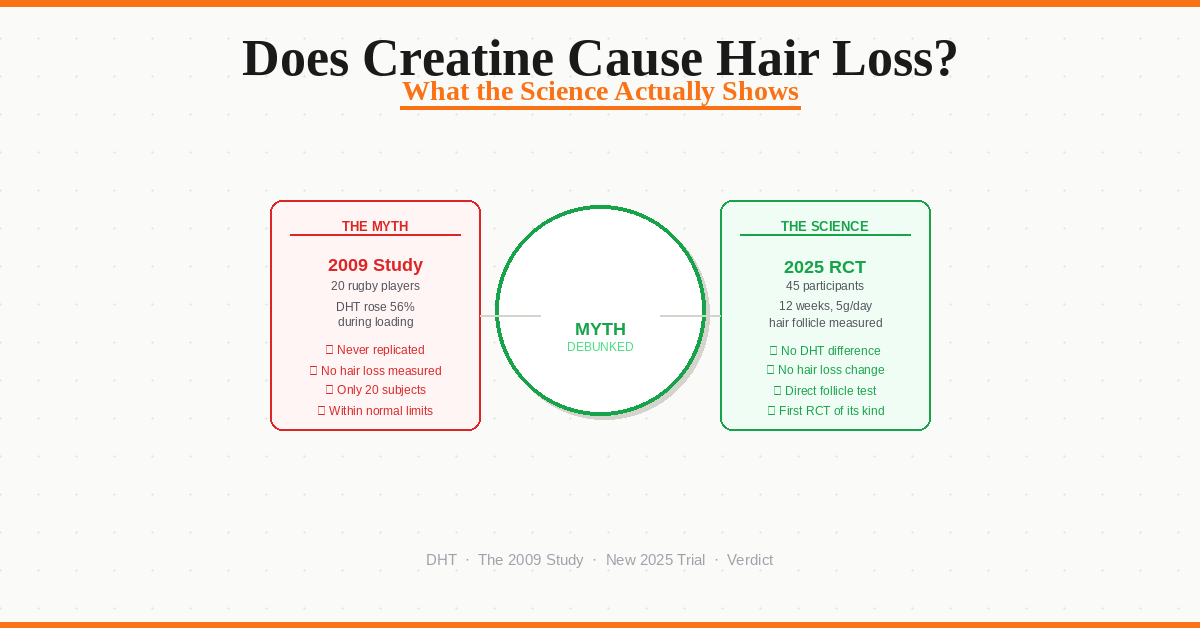
The entire creatine and hair loss concern traces back to a single study published in 2009 in the Clinical Journal of Sport Medicine. College-aged male rugby players supplemented with creatine – 25g per day for seven days followed by 5g per day for a further 14 days – and researchers measured their hormone levels before and after.
The finding that generated the headlines: DHT levels increased by 56% after the seven-day loading period and remained 40% above baseline after the 14-day maintenance period. DHT – dihydrotestosterone – is a metabolite of testosterone that can bind to androgen receptors in hair follicles susceptible to it, causing them to miniaturize over time. This process, called androgenetic alopecia, is the primary mechanism behind male pattern baldness.
So the logic seemed straightforward: creatine raises DHT, DHT causes hair loss, therefore creatine causes hair loss. The claim spread rapidly through fitness forums, social media, and supplement blogs. Fifteen years later it is still one of the most common concerns beginners raise about creatine.
The problem is that this logic has serious flaws – and the original study has significant limitations that most people sharing the claim never mention.
What the 2009 study actually found – and what it didn’t
Before accepting the 2009 study’s findings at face value it is worth examining what it actually showed and what it did not.
The DHT increase remained within normal clinical limits – The absolute increase in DHT was 0.55 nmol/L after loading. Despite the dramatic sounding 56% relative increase the final DHT levels in the creatine group were still well within the normal clinical reference range. This is a critical distinction – a 56% increase from a below-average baseline is very different from a 56% increase to an above-normal level.
The creatine group started with lower baseline DHT – The creatine group had DHT levels 23% lower than the placebo group before supplementation began. This means the apparent increase partially reflects a return toward average rather than an elevation beyond normal.
No actual hair loss was measured – The study measured DHT levels in blood samples. It did not measure hair follicle health, hair density, hair thickness, or any direct measure of hair loss. The connection between the DHT increase observed and actual hair loss is entirely theoretical.
The sample size was very small – Only 20 participants completed the study – too small to draw robust conclusions about hormone changes in the general population.
The study has never been replicated – This is perhaps the most important point. A comprehensive review published in the Journal of the International Society of Sports Nutrition identified that at least twelve additional studies have examined creatine’s effects on testosterone and DHT. None of them reported significant hormonal increases. The 2009 finding stands alone in the literature as an outlier that no subsequent research has confirmed.
The 2025 randomized controlled trial – the definitive answer
In 2025 researchers published what is now the strongest evidence available on this question – the first study to ever directly measure hair follicle health following creatine supplementation.
The study, published in PubMed, recruited 45 resistance-trained men aged 18-40 and randomly assigned them to either 5g of creatine monohydrate per day or a placebo for 12 weeks. Blood samples measured total testosterone, free testosterone, and DHT. Hair follicle health was assessed directly using the Trichogram test and the FotoFinder system – measuring hair density, follicular unit count, and cumulative hair thickness.
The results were unambiguous. There were no significant differences between the creatine and placebo groups in DHT levels, DHT-to-testosterone ratio, or any hair growth parameter. Hair density, follicular unit count, and hair thickness were identical between groups at the end of 12 weeks.
The researchers concluded that this study was the first to directly assess hair follicle health following creatine supplementation, providing strong evidence against the claim that creatine contributes to hair loss.
This is the most rigorous test of the creatine hair loss hypothesis ever conducted. It used a larger sample than the 2009 study, ran for three times as long, and directly measured the outcome everyone was actually worried about – not just hormone levels, but actual hair follicle health. The result was clear.
Does creatine affect DHT at all?
The short answer based on the totality of evidence is that standard daily creatine supplementation at 3-5g per day does not meaningfully elevate DHT levels in most people. The 2009 study used a loading protocol of 25g daily – five times the standard maintenance dose – and still produced DHT levels within normal range.
The mechanism by which creatine could theoretically affect DHT involves the enzyme 5-alpha-reductase, which converts testosterone to DHT. Some researchers have proposed that creatine may slightly increase the activity of this enzyme. However this theoretical pathway has not been confirmed in practice – the 2025 RCT found no DHT elevation even with direct measurement over 12 weeks.
It is also worth noting that DHT levels alone do not determine whether someone experiences hair loss. Hair loss from DHT requires genetic susceptibility – specifically hair follicles that are sensitive to DHT due to androgen receptor density. Most people’s hair follicles are not meaningfully sensitive to DHT fluctuations within the normal range. The people most concerned about creatine and hair loss are often those with a family history of male pattern baldness – and for this group the question is whether creatine pushes DHT above their personal threshold. Based on current evidence it does not.
Should people with a family history of hair loss avoid creatine?
This is the most nuanced question and deserves an honest answer. The 2025 RCT excluded participants with diagnosed hair loss disorders, meaning it does not fully answer what happens in people with existing androgenetic alopecia or a strong family history.
Based on the current evidence the position most clinical researchers take is that creatine at standard doses – 3-5g daily without loading – does not present a meaningful hair loss risk even in genetically susceptible individuals. The evidence that creatine raises DHT to any significant degree is not established, and the evidence that it causes actual hair loss simply does not exist.
If you have a strong family history of male pattern baldness and are concerned, the pragmatic approach is to skip the loading phase – which involves higher doses – and take 3-5g daily from day one. This avoids any theoretical transient DHT increase during the loading period while still achieving full creatine saturation after 3-4 weeks. See our creatine loading phase guide for a full breakdown of loading vs no-loading approaches.
The supplements and medications that genuinely do accelerate hair loss in susceptible individuals are anabolic steroids, SARMs, and high-dose testosterone therapy. Creatine is an amino acid derivative with a completely different mechanism and a safety profile established over decades of research. It is not in the same category.
What actually causes hair loss during exercise and supplementation
If you notice increased hair shedding after starting a new training program or supplement stack there are several more likely explanations than creatine:
Telogen effluvium from physical stress – High-intensity training – particularly when starting a new program – can trigger temporary hair shedding as a physiological stress response. This typically resolves within 3-6 months as the body adapts.
Calorie restriction – Being in a significant calorie deficit reduces the nutrients available for hair growth. Hair follicles are not a metabolic priority during energy restriction.
Protein deficiency – Hair is primarily composed of keratin – a protein. Inadequate protein intake is one of the most common nutritional causes of hair shedding. Ironically this means if you are using creatine as part of a supplement stack that includes adequate protein you are actively supporting hair health rather than undermining it. See our best protein powder guide for practical protein intake guidance.
Nutritional deficiencies – Iron, zinc, biotin, and vitamin D deficiencies are all independently linked to hair shedding. Athletes are at higher risk of these deficiencies – particularly iron in female athletes and vitamin D in indoor athletes.
Anabolic steroids – If someone is using creatine alongside anabolic steroids and notices hair loss, the steroids are the far more likely culprit. Creatine is frequently blamed because it is the visible supplement in the stack while steroid use remains private.
Frequently asked questions
Does creatine cause hair loss in women?
The research on creatine and hair loss has been conducted almost exclusively in men – reflecting a broader gap in sports nutrition research involving female participants. There is no evidence that creatine causes hair loss in women. DHT-driven androgenetic alopecia is significantly less common in women due to lower baseline androgen levels, and the theoretical mechanism linking creatine to hair loss via DHT is weaker in women for the same reason. For additional information see our creatine for women guide.
Will stopping creatine reverse hair loss?
If creatine were causing hair loss – which the evidence does not support – stopping supplementation would allow DHT levels to return to baseline and theoretically halt any creatine-driven progression. However since no study has demonstrated creatine causes hair loss in the first place there is no basis for expecting stopping creatine to reverse existing hair loss. If you are experiencing significant hair loss consult a dermatologist – the cause is almost certainly genetic, nutritional, or hormonal rather than creatine-related.
Is creatine linked to any proven side effects?
Yes – creatine has well-documented and minor side effects at standard doses. Temporary water retention and weight gain of 0.5-2kg during the first week is common and expected – this is intramuscular water not fat. Some people experience mild digestive discomfort particularly during loading at 20g per day – splitting doses and taking with food resolves this for most people. Hair loss is not among the established side effects. For a complete overview see our creatine monohydrate beginners guide.
What form of creatine is safest for hair?
All forms of creatine work through the same mechanism and would theoretically carry the same hair loss risk if one existed. Creatine monohydrate is the only form with decades of safety research. There is no evidence that creatine HCL, buffered creatine, or any other form is safer for hair than monohydrate. See our creatine HCL vs monohydrate comparison for a full breakdown of creatine forms.
Does the creatine loading phase increase hair loss risk more than standard dosing?
The 2009 study that started the concern used a loading protocol at 25g daily – five times a standard maintenance dose. If any creatine protocol carries a theoretical risk it would be high-dose loading. The pragmatic approach for anyone concerned is to skip loading and take 3-5g daily from day one. Full saturation takes 3-4 weeks instead of one but the end result is identical and avoids any transient hormone effects that higher doses might theoretically produce. For more detail see our how long does creatine take to work guide.
The bottom line
Does creatine cause hair loss? Based on the current body of evidence – including a 2025 randomized controlled trial that directly measured hair follicle health over 12 weeks and found zero difference between creatine and placebo – the answer is no. The concern originates from a single small study that measured DHT levels in blood, not hair follicles, in only 20 subjects during a high-dose loading protocol. That finding has never been replicated in 15 years of subsequent research. Creatine is the most studied sports supplement in existence with a safety profile established over decades. Hair loss is not among its established side effects. If you have been avoiding creatine because of this concern the science does not support that decision.