Vitamin D for Athletes: Performance, Recovery, and Dosing Explained (2026)
Most people think of vitamin D as a bone health supplement for older adults. Athletes think of it as something they probably don’t need to worry about. Both assumptions are wrong – and the research on vitamin D for athletes makes a compelling case that it deserves a place in any serious training supplement stack. Vitamin D is a hormone-like compound that influences muscle function, immune response, injury risk, and recovery – and the majority of people who train regularly are deficient without knowing it. This guide covers what the research actually shows, who needs to supplement, how much to take, and the best options available in 2026.
Note: This post contains affiliate links. If you buy through our links we may earn a commission at no extra cost to you.
What vitamin D actually does in the body
Vitamin D is technically a misnomer – it functions more like a hormone than a traditional vitamin. Unlike most vitamins that must be obtained entirely from diet, vitamin D is synthesized in the skin through exposure to UVB radiation from sunlight and then converted in the liver and kidneys into its active hormonal form, calcitriol. Vitamin D receptors are found in virtually every tissue in the body including skeletal muscle, immune cells, bone, and the brain – which explains why its effects extend far beyond calcium absorption and bone metabolism.
For people who train, the most relevant functions are in skeletal muscle directly. Vitamin D receptors in muscle tissue influence protein synthesis, muscle fiber composition, and neuromuscular coordination. Low vitamin D status weakens these signaling pathways, reducing force production and increasing injury risk. Research published in Frontiers in Physiology confirmed that vitamin D promotes skeletal muscle regeneration and mitochondrial health – both directly relevant to training adaptation and recovery.
Why vitamin D deficiency is common in people who train
The counterintuitive reality is that active people – including regular gym-goers and competitive athletes – are not protected from vitamin D deficiency by their lifestyle. In fact several factors specific to training increase deficiency risk.
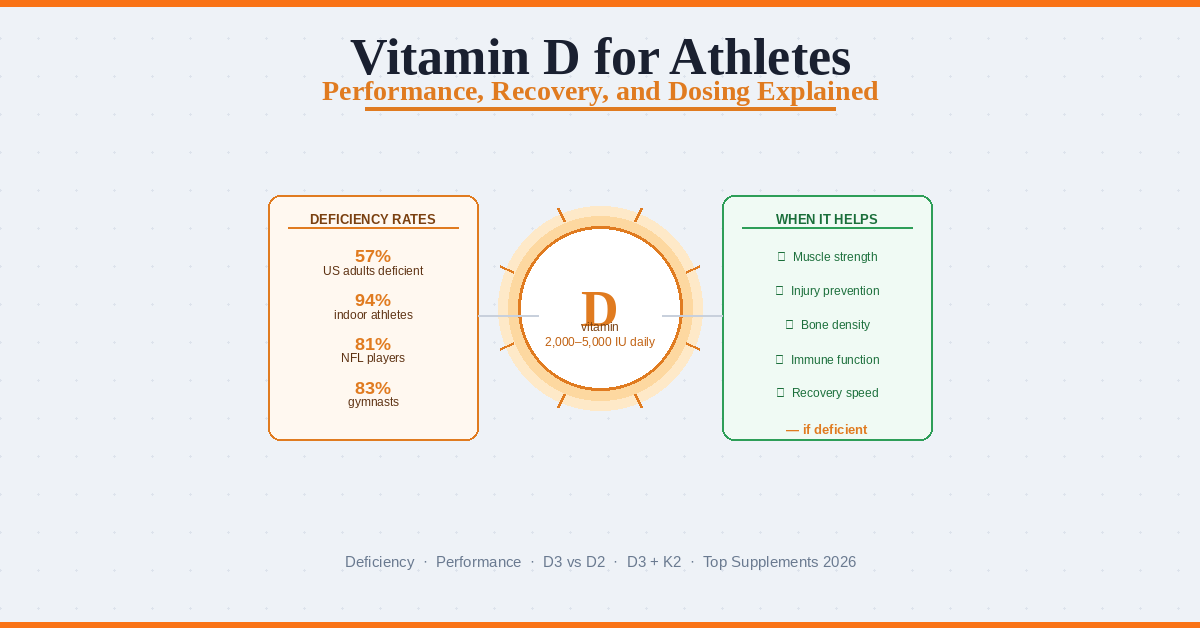
Indoor training – The single biggest factor. Vitamin D synthesis requires direct UVB exposure to bare skin – glass blocks UVB completely, meaning time near windows does not count. Anyone training primarily indoors receives minimal sun-driven vitamin D synthesis regardless of how many hours they spend in the gym. Studies have found vitamin D deficiency in up to 94% of indoor sport athletes including basketball players and gymnasts.
Northern latitudes – Above approximately 37 degrees north latitude – which includes most of the United States, Canada, and Europe – UVB radiation is insufficient to drive meaningful vitamin D synthesis for several months of the year, typically October through March. In Minnesota, for example, meaningful vitamin D synthesis from sunlight is essentially impossible for five to six months annually.
Skin pigmentation – Melanin in darker skin absorbs UVB radiation, reducing vitamin D synthesis efficiency. Athletes with darker skin tones have significantly higher deficiency rates – studies of NFL players during spring training found 81% were deficient, with higher rates among Black athletes.
High training volumes – Intense exercise appears to increase vitamin D turnover, potentially increasing requirements beyond what sedentary individuals need. Elite athletes training at high volumes have higher deficiency rates than recreational exercisers despite similar sun exposure.
Sunscreen use – SPF 15 reduces vitamin D synthesis by approximately 99%. Athletes who apply sunscreen before outdoor training – which is recommended for skin health – almost entirely block sun-driven vitamin D synthesis.
Research published in the Journal of the International Society of Sports Nutrition identified vitamin D deficiency rates of 36-57% across the general US adult population, with athletes in indoor sports reaching deficiency rates approaching 94%. The conclusion from the research community is clear – vitamin D deficiency in athletes is a genuine and widespread problem, not a niche concern.
What the research shows about vitamin D for athletes
This is where honest nuance matters. The research on vitamin D and performance is genuinely mixed – and the reason for the mixed results is now well understood. Vitamin D supplementation improves performance and recovery specifically in people who are deficient. In people with already adequate vitamin D levels the benefits are minimal to absent.
A 2023 meta-analysis published in Frontiers in Nutrition summarized the available randomized controlled trial data on vitamin D supplementation and muscle strength and power in athletes. The conclusion was that vitamin D supplementation can improve lower limb muscle strength in athletes – with larger effects specifically in those deficient at baseline. Athletes with adequate vitamin D status showed little to no benefit from additional supplementation.
This finding has important practical implications. If you are already sufficient – which requires knowing your blood level – supplementing further provides minimal performance benefit. If you are deficient – which, given the statistics, is the more likely scenario for most gym-goers – correcting your vitamin D status can meaningfully improve muscle strength, recovery, and injury resilience.
Specific performance areas where the evidence is strongest for deficient individuals:
Muscle strength – Multiple studies show measurable improvements in both upper and lower body strength when deficient individuals correct their vitamin D status. A 2015 meta-analysis found supplementation significantly improved strength in participants with 25(OH)D levels below 25 nmol/L.
Muscle recovery after exercise – Research published in PMC found that vitamin D supplementation improved maximal voluntary contraction recovery at 48 hours and seven days after eccentric exercise-induced muscle damage in individuals with insufficient vitamin D status – directly relevant to training frequency and progressive overload.
Injury prevention – Lower vitamin D status is associated with higher rates of stress fractures, muscle strains, and soft tissue injuries. Studies in professional athletes have found that deficient athletes experience significantly more training-related injuries than those with optimal status.
Immune function – Intense training suppresses immune function temporarily – a well-established phenomenon. Vitamin D plays a direct role in immune regulation, and deficient athletes experience higher rates of upper respiratory tract infections during heavy training periods, which disrupts training consistency.
The evidence base regarding vitamin D for athletes has grown substantially over the past decade.”
Vitamin D2 vs D3 – why it matters which one you choose
There are two forms of supplemental vitamin D – D2 (ergocalciferol) and D3 (cholecalciferol). The difference matters and the answer is straightforward. Always choose D3.
Vitamin D3 is the form naturally produced in human skin and is significantly more effective at raising and maintaining blood vitamin D levels than D2. Multiple studies have confirmed that D3 is approximately 87% more potent than D2 at raising serum 25(OH)D levels. D2 is derived from plant sources and while it does raise vitamin D levels it is less efficient and produces a shorter duration of effect.
Some multivitamins and lower quality supplements still use D2 – check the label. If it says ergocalciferol it is D2. If it says cholecalciferol it is D3. Choose D3 every time. For a full overview of what to look for in a multivitamin supplement for athletes see our best multivitamin for athletes guide.
Should you take vitamin D3 with K2?
Vitamin K2 has become a common addition to vitamin D3 supplements and the reasoning is scientifically sound. Vitamin D3 increases calcium absorption from the gut – which is one of its primary functions. Vitamin K2 (specifically the MK-7 form) activates proteins including osteocalcin and matrix GLA proteins that direct calcium to bones and teeth rather than allowing it to deposit in soft tissues and arteries.
The concern that high-dose vitamin D supplementation without adequate K2 may contribute to arterial calcification is biologically plausible though not definitively proven in human trials. The practical recommendation from most sports nutrition researchers is that if you supplement vitamin D3 at 2,000 IU or above – particularly at 4,000-5,000 IU — pairing it with 100-200mcg of vitamin K2 MK-7 is a sensible precaution with no known downside.
Combined D3+K2 supplements are widely available and typically cost no more than standalone D3. If you have a family history of cardiovascular disease or are supplementing at higher doses the combination is worth prioritizing.
Vitamin D and magnesium – the connection most people miss
This is the most underappreciated aspect of vitamin D supplementation. Magnesium is required for every step of vitamin D metabolism – from synthesis in the skin to conversion into its active hormonal form in the liver and kidneys. Without adequate magnesium vitamin D supplements are significantly less effective regardless of the dose taken.
Research published in Nutrients confirmed that magnesium is found in every step of the metabolization of vitamin D. Athletes are already at higher risk of magnesium deficiency due to losses through sweat and increased demand from intense exercise – making the vitamin D and magnesium connection particularly relevant for regular trainers.
The practical implication is simple: if you are supplementing vitamin D make sure your magnesium intake is adequate. For a full breakdown see our magnesium for muscle recovery guide and our magnesium glycinate vs citrate comparison for guidance on the best form to supplement.
How much vitamin D do athletes need?
The official recommended daily allowance of 600-800 IU is widely considered inadequate by sports medicine researchers for athletic populations. Most researchers and practitioners working with athletes recommend targeting a serum 25(OH)D level of 40-60 ng/mL as the optimal range for performance and health.
Achieving this from deficiency typically requires 2,000-5,000 IU of vitamin D3 daily depending on baseline levels, body composition, skin tone, and sun exposure. Athletes training primarily indoors in northern climates during winter months are at the higher end of this range.
The only way to know your actual vitamin D status is through a blood test measuring serum 25(OH)D. A standard metabolic panel from your doctor includes this test. If you have not tested and train primarily indoors, supplementing 2,000 IU daily is a reasonable and safe starting point for most healthy adults. Upper tolerable intake level is typically set at 4,000 IU daily for adults without medical supervision – toxicity from vitamin D is rare but possible with chronic very high dose supplementation.
Best vitamin D supplements for athletes (2026)
Sports Research Vitamin D3 + K2 – The best overall vitamin D supplement for athletes. Delivers 5,000 IU of D3 with 100mcg of K2 MK-7 in a small, easy-to-swallow softgel with organic olive oil for enhanced absorption. Vegan-friendly, non-GMO, third-party tested. The D3+K2 combination at this dose is exactly what most deficient athletes need and Sports Research is one of the most trusted supplement brands for quality and purity.

- D3 + K2 – TEAMWORK THAT MATTERS: Vitamins D3 and K2 work synergistically to support strong bones, immune health, and pro…
- PLANT-BASED, VEGAN-FRIENDLY FORMULA: Our D3 + K2 supplement uses vegan D3 (cholecalciferol) sourced from lichen and K2 (…
- ONCE-A-DAY IMMUNE & BONE SUPPORT: Each easy-to-swallow softgel delivers 125 mcg (5000 IU) of vegan D3 and 100 mcg of K2 …
Best for: Athletes who want the D3+K2 combination at a clinically relevant dose with strong third-party testing credentials.
Nature Made Vitamin D3 2000 IU – The best entry-level vitamin D supplement for athletes beginning to address deficiency. USP verified – the most rigorous third-party certification for supplement accuracy and purity – and widely available at supermarkets and pharmacies. At 2,000 IU this is an appropriate starting dose for most people supplementing without recent blood testing.

- Immune, muscle, teeth and bone health support supplement: contains one 250 count bottle of Nature Made Vitamin D3 2000 I…
- Nature Made Vitamin D 2000 IU softgels support bone health, teeth health, muscle health, and provide immune support
- These Vitamin D 2000IU softgels help improve calcium absorption and contain 50mcg of Vitamin D 3, the body’s preferred f…
Best for: Athletes starting vitamin D supplementation for the first time, anyone who wants USP verified quality at an accessible price point.
Thorne Vitamin D3 + K2 – The premium choice for athletes who want maximum quality assurance. NSF Certified for Sport – the most rigorous certification for competitive athletes concerned about banned substances. Delivers 1,000 IU D3 with 200mcg K2 MK-7 per drop in a liquid format that allows precise dose adjustment. Particularly useful for athletes who need to adjust their dose based on blood test results.

- Bone & Muscle Health: Both vitamin D and vitamin K2 provide advanced support for bone and muscle health, as well as card…
- Promotes Calcium Absorption: Vitamin D is necessary for calcium absorption, and vitamin K is important for directing cal…
- Combo Effect: A convenient self-dispensing top provides accurate dosing of individual drops of well-tolerated vitamins D…
Best for: Competitive athletes in drug-tested sports, anyone who wants NSF Certified for Sport verification, those who need flexible dosing.
NOW Foods Vitamin D3 5000 IU – The best budget option for athletes who have confirmed deficiency and need a higher dose to correct it. NOW Foods is one of the most reputable supplement manufacturers for quality at accessible price points. GMP certified, third-party tested, straightforward formulation. At 5,000 IU this is appropriate for athletes with confirmed deficiency working to restore optimal levels under medical guidance.
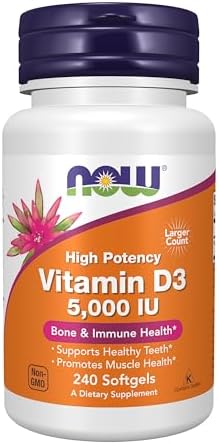
- HIGH POTENCY/SUNSHINE VITAMIN: Highly-absorbable liquid softgel form of vitamin D3
- VITAMIN D: Supports healthy immune system function and is essential for achieving and maintaining optimal bone mineral d…
- CERTIFICATIONS/CLASSIFICATIONS: Corn Free, Dairy Free, Egg Free, Halal, Kosher Contains Gelatin, Made without Gluten, No…
Best for: Athletes with confirmed deficiency who need a higher correction dose at a budget-friendly price.
Frequently asked questions
Should athletes take vitamin D every day?
Yes – vitamin D is a fat-soluble vitamin that accumulates in tissue over time, but daily supplementation is the most effective approach for maintaining consistent blood levels. Taking it with a meal containing fat improves absorption significantly since vitamin D is fat-soluble. Daily dosing is more effective than weekly high-dose supplementation for maintaining stable serum levels throughout the year.
Can you get enough vitamin D from sunlight alone?
Potentially in summer months at lower latitudes with significant sun exposure to large skin areas without sunscreen. In practice most people who train regularly cannot rely on sunlight alone – indoor training, sunscreen use, northern latitudes, and winter months all severely limit synthesis. Testing your blood level is the only reliable way to know whether sun exposure is sufficient for your specific situation.
Does vitamin D help with muscle soreness?
The evidence suggests vitamin D helps with muscle recovery specifically in deficient individuals – improving the restoration of muscle strength after exercise-induced damage. Direct effects on DOMS (delayed onset muscle soreness) are less clearly established. The most consistent finding is that correcting deficiency reduces injury risk and improves the rate of strength recovery between training sessions rather than directly reducing soreness. For magnesium’s role in recovery see our magnesium for muscle recovery guide.
Is vitamin D3 better than D2 for athletes?
Yes – vitamin D3 is significantly more effective at raising and maintaining serum 25(OH)D levels than D2. Always choose supplements listing cholecalciferol on the label. D2 (ergocalciferol) is less potent and produces a shorter duration of elevated blood levels. No reputable sports nutrition researcher recommends D2 over D3 for athletic populations.
When is the best time to take vitamin D?
With your largest meal of the day – vitamin D is fat-soluble and absorption is enhanced by dietary fat. Breakfast or dinner with food works well. Avoid taking it late at night as some research suggests vitamin D may affect melatonin production and sleep quality when taken in the evening, though this evidence is not conclusive.
The bottom line
Vitamin D deficiency is more common among people who train than most gym-goers realize – particularly indoor athletes, those in northern climates, and anyone training through winter months. The research is clear that correcting deficiency produces measurable improvements in muscle strength, recovery, injury resilience, and immune function. The key word is correcting – if you are already sufficient, additional supplementation produces minimal benefit.
Testing your serum 25(OH)D level is the most useful step you can take. If testing is not practical supplementing 2,000 IU of vitamin D3 daily is safe and appropriate for most healthy adults who train regularly indoors. Pair it with K2 MK-7 at higher doses and ensure adequate magnesium intake for optimal activation. D3 only – never D2.
Vitamin D for athletes is not a performance enhancer in the traditional sense – it is a corrective measure that restores function.