Creatine and Caffeine: Does Coffee Cancel Out Creatine? (2026)
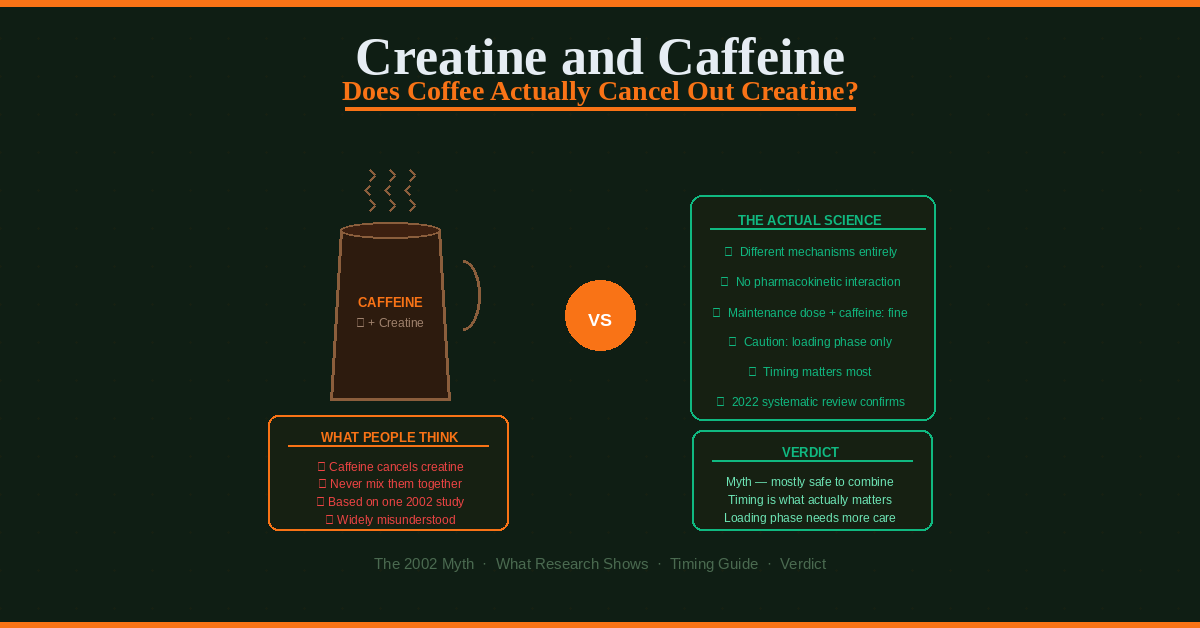
If you drink coffee and take creatine you have almost certainly heard this warning: caffeine cancels out creatine, so never take them together. It gets repeated confidently in gyms, on fitness forums, and in YouTube videos. It is also largely a myth – one that traces back to a single study from 2002 that has been misrepresented and overstated for over two decades. The honest answer about creatine and caffeine is more nuanced than either “they’re fine together” or “never mix them” – and understanding the actual science changes how most people should approach their supplement timing.
How creatine and caffeine work – why they’re fundamentally different
Understanding why this question gets complicated requires a quick look at what each compound actually does in the body.
Creatine works by saturating your muscle cells with phosphocreatine – a stored form of rapid energy used during high-intensity efforts lasting 10 seconds or less. More phosphocreatine means faster ATP regeneration, which means more power output, more reps before fatigue, and better recovery between sets. Creatine works through a cellular energy mechanism – it is not a stimulant and does not affect the central nervous system. For a full explanation see our creatine monohydrate beginners guide.
Caffeine works through a completely different mechanism. It is a central nervous system stimulant that blocks adenosine receptors in the brain – preventing the fatigue signal from registering and increasing alertness, motivation, and pain tolerance during exercise. Caffeine’s primary performance benefits come through the brain and nervous system, not through muscle cell energy stores.
These two mechanisms are independent. Creatine does not affect adenosine receptors. Caffeine does not affect phosphocreatine stores. On paper there is no obvious reason why one should cancel the other out. So where did the concern come from?
Where the creatine and caffeine myth came from
The cancellation myth traces almost entirely back to a single study published in 2002 by Vandenberghe and colleagues. The researchers found that caffeine supplementation prolonged muscle relaxation time – specifically, the time it takes for a muscle fiber to relax between contractions. Creatine supplementation, by contrast, shortens muscle relaxation time. In theory these opposing effects could cancel each other out in terms of performance.
The study generated significant attention and the conclusion – that caffeine blunts creatine’s benefits – became widely accepted in fitness communities almost immediately.
What the study really showed and why it matters less than people think:
The finding was about muscle relaxation time measured in isolated lab conditions – not about athletic performance, strength gains, or muscle hypertrophy in the real world. Muscle relaxation time is one narrow physiological variable. Whether opposing effects on this specific variable translate to meaningful real-world performance differences is a separate question the study did not answer.
The 2002 study also used a specific protocol – daily caffeine supplementation during a creatine loading phase – that does not reflect how most people actually use these supplements. Most people drink coffee in the morning and take their creatine at some point during the day, not simultaneously at high doses every day during a loading phase.
What the research actually shows
Since 2002 multiple studies have directly examined whether creatine and caffeine interfere with each other in practice. The results are genuinely mixed – which is itself an important finding.
The clearest evidence against serious interference:
A 2015 review published in PubMed found no pharmacokinetic interactions between caffeine and creatine – meaning the two compounds do not affect how the other is absorbed, distributed, or metabolized in the body. They are processed through entirely separate pathways. This is a critical finding because if there were no pharmacokinetic interactions, any performance interference must have come from the opposing physiological effects rather than a direct chemical conflict.
A 2017 study published in PMC examined 54 male resistance-trained athletes divided into four groups – creatine alone, creatine plus caffeine anhydrous, creatine plus coffee, and placebo – over five days of supplementation. The result: no significant differences in power or sprinting performance between any of the groups. Strength measures improved across all supplemented groups with no significant difference between creatine alone and creatine combined with caffeine. Four participants in the creatine plus caffeine group reported mild gastrointestinal discomfort – the only notable difference between groups.
The nuanced evidence for caution in specific protocols:
A 2022 systematic review published in PubMed examined ten studies on concurrent creatine and caffeine supplementation. The findings were genuinely mixed. Three studies found that creatine loading followed by an acute caffeine dose before exercise showed no interference. Two studies found that chronic daily co-supplementation – taking both together every day throughout the loading phase – did show caffeine interfering with creatine’s ergogenic effect. Three studies found no interaction at all. One study even showed synergy.
What this means in plain terms:
The interference effect, when it does appear, is associated with a specific protocol – high dose daily caffeine taken simultaneously with creatine every day during a loading phase. This is not the same as drinking a morning coffee and taking your daily 5g creatine at some point during the day. The research does not support the blanket claim that caffeine cancels creatine for normal users following standard supplementation practices.
The one scenario where caution is genuinely warranted
Based on the current evidence the only situation where the creatine and caffeine interaction deserves real consideration is during a high-dose creatine loading phase combined with daily high-dose caffeine supplementation.
Specifically – if you are loading creatine at 20g per day split into four doses and simultaneously taking 300mg or more of caffeine anhydrous every day throughout the loading week, some research suggests this protocol may blunt the loading effect.
The practical implications are limited because most people do not need to load creatine. Taking 3-5g daily from day one achieves identical muscle saturation after 3-4 weeks with none of the gastrointestinal discomfort that loading can cause. See our creatine loading phase guide for a full breakdown of whether loading is right for you.
If you do choose to load and you consume significant daily caffeine the most conservative approach is to keep them separated by several hours during the loading week – caffeine in the morning, creatine doses spread throughout the day away from your caffeine peak. After the loading phase is complete and you are on 3-5g maintenance dosing the evidence for any interference essentially disappears.
Can you mix creatine in your coffee?
This is one of the most practical questions people ask about creatine and caffeine – and the answer is yes with one small caveat.
Creatine monohydrate dissolves reasonably well in warm water. Hot coffee at typical drinking temperature – around 60-70°C – does not degrade creatine meaningfully. A study comparing creatine mixed in coffee versus creatine taken separately found no significant difference in absorption or performance. The concern that heat destroys creatine is not supported by the evidence at normal beverage temperatures.
The small caveat is that creatine does not dissolve as cleanly in coffee as in plain water – you may notice some grittiness or undissolved powder depending on the creatine particle size. Micronized creatine dissolves significantly better than standard creatine monohydrate powder. Stirring thoroughly and drinking immediately rather than letting it sit resolves most mixability issues.
If your routine is to drink coffee in the morning before training and you want to add creatine to it – go ahead. The convenience of a single morning drink is a genuine practical benefit and the research does not suggest any meaningful downside for most people following maintenance dosing.
The best approach to taking creatine and caffeine together
Based on the current evidence here is the practical guidance that most people should follow:
For most people on maintenance dosing – timing is flexible: Take your 3-5g of creatine whenever it fits your routine. Morning coffee, post-workout shake, with lunch – consistency matters far more than precise timing relative to caffeine. See our when to take creatine guide for a full timing breakdown.
If you use a loading phase – keep them separated: During your 5-7 day loading phase take caffeine in the morning and space your creatine doses away from your highest caffeine consumption periods. This is the conservative approach that addresses the specific protocol where interference has been observed.
Watch for gastrointestinal discomfort: The most consistent finding across studies is that combining creatine and caffeine increases the likelihood of digestive discomfort compared to either supplement alone. If you experience stomach upset try separating them by 2-3 hours rather than taking them simultaneously.
Standard caffeine timing still applies: Whether you are taking creatine or not avoid caffeine within 6 hours of bedtime – the sleep disruption from late caffeine is a genuine concern regardless of creatine. Poor sleep undermines the muscle recovery and growth that creatine is supporting. See our best pre-workout without caffeine guide if you train in the evening and want performance benefits without the sleep disruption risk.
Caffeine is not required: Creatine works effectively completely independently of caffeine. If you are caffeine sensitive, experience anxiety or elevated heart rate from stimulants, or train in the evening – creatine alone delivers its full performance benefits with no interaction to worry about.
Frequently asked questions
Does coffee cancel out creatine?
No – the evidence does not support the claim that drinking coffee cancels creatine’s benefits for most people following standard supplementation protocols. The concern originates from a 2002 study examining muscle relaxation time in lab conditions that has been overstated and misrepresented. A 2017 study with 54 participants found no significant performance differences between creatine alone and creatine combined with caffeine. The nuance is that high dose daily caffeine during a creatine loading phase may blunt some of the loading effect – but maintenance dosing combined with moderate daily caffeine appears safe for most people.
Can you take creatine and caffeine at the same time?
Yes for most people – taking your creatine dose with or close to your coffee does not produce meaningful interference for the majority of users. The exception is during a high dose loading phase where keeping them separated by a few hours is the conservative approach. For standard 3-5g maintenance dosing timing relative to caffeine matters very little.
Is creatine better than caffeine for performance?
They work through different mechanisms and are not directly comparable. Caffeine provides an acute performance boost on the day you take it – useful for high-intensity training sessions, competition, or any training where you need to push harder on a specific day. Creatine builds up over weeks of consistent supplementation and provides ongoing improvements in strength, power, and recovery. Most athletes benefit from both – creatine as a daily foundation supplement and caffeine strategically around key training sessions.
Does creatine have caffeine in it?
No – pure creatine monohydrate contains no caffeine whatsoever. Some pre-workout supplements contain both creatine and caffeine as separate ingredients – always check the label if you are monitoring your caffeine intake. If you want creatine without any stimulants choose a standalone creatine monohydrate powder with no additional ingredients.
Can you take creatine if you drink coffee every day?
Yes – daily moderate coffee consumption is not a reason to avoid creatine supplementation. The research does not support avoiding creatine for regular coffee drinkers. Take your creatine consistently every day as you normally would and drink your coffee as usual. The only consideration worth noting is during a creatine loading phase where spacing them apart is a sensible precaution.
The bottom line
The claim that caffeine cancels out creatine is a significant overstatement of a narrow 2002 lab finding. The research since then – including a 2022 systematic review of ten studies – shows mixed results with no consistent interference effect at the doses and protocols most people actually use. For the vast majority of people taking 3-5g of creatine daily alongside moderate caffeine consumption there is no meaningful interaction to worry about.
The one scenario that warrants caution is high dose daily caffeine taken simultaneously throughout a creatine loading phase – if you are loading, keep them separated. If you are on maintenance dosing, drink your morning coffee, stir your creatine in if you want, and focus on training consistently – that is what actually drives results.