How Long Does Creatine Take to Work? A Realistic Timeline (2026)
Most people start taking creatine and expect to feel something within a day or two. When nothing obvious happens they wonder if it’s working, if they bought a bad product, or if creatine is overrated. None of these are likely. A lot of people ask us “how long does creatine take to work?” Creatine is not caffeine – it doesn’t produce an immediate, perceptible effect. It works by gradually saturating your muscle cells with phosphocreatine, and that process takes time.
This guide gives you an honest, realistic timeline for what to expect, when to expect it, and what actually determines how quickly creatine works for you specifically.
How creatine works and why it takes time
Before looking at timelines it helps to understand the mechanism. Creatine works by increasing the amount of phosphocreatine stored in your muscle cells. Phosphocreatine is used to rapidly regenerate ATP – the primary energy currency your muscles use during high-intensity exercise. More phosphocreatine means faster ATP regeneration, which means more power output, less fatigue between sets, and better recovery.
The critical point is that your muscles need to be saturated with creatine before you feel the full effect. Your muscles have a finite storage capacity for creatine – typically around 150-160 mmol per kilogram of dry muscle mass. Until those stores are close to full you won’t experience the performance benefits. Getting from your baseline to full saturation is what takes days to weeks depending on your approach. For a complete overview of creatine fundamentals see our creatine monohydrate beginners guide.
How long does creatine take to work – with a loading phase
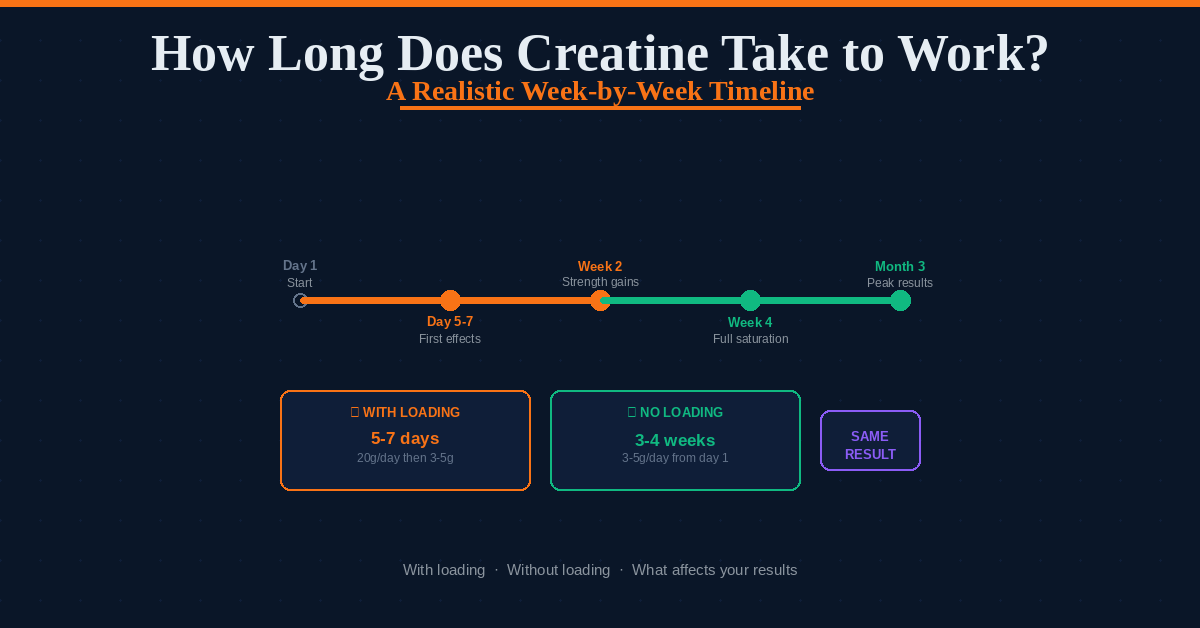
A loading phase – 20g per day split into four 5g doses for 5-7 days – is designed to saturate your muscles as fast as possible. Here is what the timeline looks like:
Days 1-2: Nothing noticeable. Your muscles are beginning to absorb creatine but stores are still well below saturation. Some people notice very slight increases in body weight from the water retention beginning – this is a sign the process is working.
Days 3-5: The first tangible sign creatine is working appears – a slight increase in muscle fullness as water is drawn into muscle cells alongside creatine. You may notice your muscles look slightly fuller in the mirror. Scale weight typically increases 0.5-1.5kg at this point – this is intramuscular water, not fat.
Days 5-7: The first performance improvements become noticeable for most people. Research published in the Journal of Applied Physiology found muscle creatine stores increased by approximately 20% within the first five days of loading – sufficient to begin affecting ATP regeneration meaningfully. You may notice you can push out one or two extra reps on your final sets, or that you recover faster between sets.
Week 2 onward: You have dropped to the maintenance dose of 3-5g daily. Muscle creatine stores are near full saturation. Performance improvements become more consistent and noticeable – better training volume, reduced fatigue, improved recovery between sessions. Strength improvements become measurable at this stage.
Summary with loading: First noticeable effects in 5-7 days. Full performance benefits within 2 weeks. Continued muscle and strength gains compound over 8-12 weeks of consistent training.
How long does creatine take to work – without a loading phase
Taking 3-5g daily from day one without a loading phase produces identical long-term results through a slower accumulation process. Here is the no-loading timeline:
Week 1: No noticeable effects for most people. Creatine stores are beginning to build but are still well below saturation. This is the patience phase – nothing is going wrong, the process just takes longer.
Week 2: Very subtle signs may begin – slight increase in muscle fullness, marginally better recovery. Most people don’t notice anything definitive yet.
Week 3: Creatine stores are approaching meaningful elevation. Some people begin noticing slightly better workout performance at this stage – particularly in terms of training volume and inter-set recovery.
Week 4: Full saturation is typically reached by the end of week four for most people taking 3-5g daily. A classic study in the Journal of Applied Physiology confirmed that the same saturation level achieved in 5 days with loading is reached after 28 days of taking 3g daily – the destination is identical, just the route is slower.
Week 4 onward: Performance benefits equivalent to the loading approach – better training volume, reduced fatigue, improved recovery. Strength and muscle gains accumulate with consistent training over the following months.
Summary without loading: First noticeable effects around weeks 3-4. Full performance benefits by week 4-5. Same long-term results as loading – just a longer wait to get there.
Factors that affect how quickly creatine works for you
The 7-28 day window is an average. Where you fall on that spectrum depends on several individual factors.
Your diet and baseline creatine stores – This is the biggest variable. People who eat red meat and fish regularly already have higher baseline muscle creatine stores – they have less room to fill and may experience a smaller, slower response. Vegetarians and vegans have significantly lower baseline stores because dietary creatine comes almost exclusively from animal products. Research consistently shows that vegetarians respond to creatine supplementation more dramatically and often faster than omnivores – their muscles have more room to absorb creatine and therefore experience a larger performance benefit.
Training intensity – Creatine uptake into muscle cells is enhanced by insulin and by muscle contraction itself. People training at high intensity with compound movements several times per week drive more creatine into muscle tissue than people doing light exercise. If you are training hard and consistently your muscles will saturate faster and the performance benefits will become apparent sooner.
Individual muscle fiber composition – People with a higher proportion of fast-twitch muscle fibers tend to have higher creatine storage capacity and often respond more noticeably to supplementation. This is partly genetic and not something you can control – but it explains why some people feel creatine working strongly and others feel a more modest effect.
Hydration – Creatine draws water into muscle cells – adequate hydration is essential for this process. People who are consistently well hydrated throughout the day will notice better muscle fullness and faster saturation than those who are chronically dehydrated. Aim for 2.5-3 liters of water daily while supplementing.
Consistency – This sounds obvious but creatine requires daily supplementation – including rest days – to maintain elevated muscle stores. Missing doses regularly significantly delays the timeline and reduces the overall effect. Daily consistency is more important than perfect timing around workouts.
Are you a creatine non-responder?
This is the honest section most creatine articles skip. Approximately 25-30% of people experience minimal benefit from creatine supplementation. These individuals are called non-responders and the reason is straightforward – their baseline muscle creatine stores are already near maximum capacity, leaving little room for supplementation to make a meaningful difference.
Non-responders are typically omnivores who eat significant amounts of red meat and fish regularly, have naturally high muscle creatine levels, and have a muscle fiber composition that stores creatine efficiently. If you have been supplementing consistently for 6-8 weeks with no noticeable improvement in training performance or recovery, non-responder status is a possibility worth considering.
There is no reliable way to test for non-responder status without muscle biopsy which is obviously impractical. The practical approach is to supplement consistently for 8 weeks – long enough to give it a fair trial – and assess honestly whether your training performance has improved. If you see no benefit after 8 weeks of consistent 3-5g daily supplementation the evidence is not supporting continued use for your specific physiology.
Signs creatine is working
Knowing what to look for helps you assess whether creatine is doing its job:
Increased scale weight in the first week – 0.5-2kg of weight gain from intramuscular water retention is a reliable early sign that creatine is being absorbed and stored. This is not fat gain.
Fuller-looking muscles – the intramuscular water that accompanies creatine makes muscles appear fuller and more volumized. This is often the first visible sign.
Extra reps on final sets – the most meaningful performance signal. If you’re managing one or two additional reps on your last sets compared to before supplementation, creatine’s ATP-regeneration benefit is working.
Faster recovery between sets – less fatigue during rest periods and feeling ready to go sooner than normal is a direct sign of improved phosphocreatine resynthesis.
Better training volume overall – being able to do more total work in a session – more sets, more reps – over several weeks of creatine use is the most important long-term indicator.
Signs creatine might not be working
No weight change after 2 weeks – if the scale has not moved at all after two weeks of consistent supplementation it may indicate poor absorption or non-responder status. Make sure you are taking it daily and with adequate water.
No performance change after 6-8 weeks – if training volume and recovery feel identical to before supplementation after six to eight weeks of consistent use, consider whether you may be a non-responder.
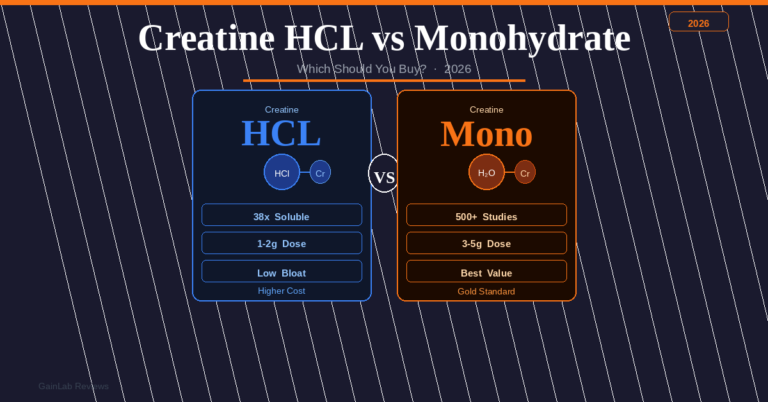
Using an inferior form – creatine ethyl ester, buffered creatine, and some proprietary forms have significantly weaker evidence than monohydrate. If you are not using creatine monohydrate switch to it before concluding creatine doesn’t work for you. See our creatine HCL vs monohydrate comparison for more detail on which forms are worth using.
Frequently asked questions
How long does creatine take to work without loading?
Without a loading phase taking 3-5g daily produces full muscle saturation after approximately 28 days. First subtle effects may appear around weeks 3-4. The end result is identical to loading – it simply takes longer to get there. For most beginners skipping the loading phase and taking 3-5g daily is the preferred approach – less digestive discomfort and the same outcome.
Can you feel creatine working on the first day?
No – creatine does not produce any acute perceptible effect on day one. Unlike caffeine which acts within 30-60 minutes through CNS stimulation, creatine works by gradually filling muscle phosphocreatine stores. There is nothing to feel on day one – this is normal and expected.
Does creatine work faster if you take more?
Loading at 20g per day for 5-7 days saturates muscles faster than 3-5g daily. Beyond the loading dose there is no benefit to taking more – once muscles are saturated they cannot store additional creatine and the excess is excreted in urine. Taking more than 5g daily after the loading phase provides no additional performance benefit. See our creatine loading phase guide for a full breakdown.
How long does creatine take to work for muscle growth?
Visible muscle growth from creatine takes 8-12 weeks of consistent supplementation combined with resistance training. Creatine does not directly cause muscle growth – it enables you to train harder and recover faster, which drives greater training adaptations over time. The initial weight gain in the first 1-2 weeks is water not muscle. Actual lean mass gains become measurable after 2-3 months of consistent training and supplementation.
Does creatine timing affect how quickly it works?
Timing is less important than daily consistency. Taking creatine at the same time every day – whether pre-workout, post-workout, or with a meal – maintains consistent muscle creatine levels more effectively than sporadic dosing. Post-workout with a protein shake and carbohydrate source has modest research support for slightly enhanced uptake but the difference is small. For comprehensive timing guidance see our when to take creatine guide.
Will creatine work for women?
Yes – creatine works through the same mechanism in women as in men. Women tend to have lower baseline muscle creatine stores than men which means the relative benefit from supplementation can actually be greater. The timeline is the same – 5-7 days with loading, 3-4 weeks without. For a complete guide to creatine for women including dosing and myths see our creatine for women guide.
The bottom line
How long creatine takes to work depends primarily on whether you use a loading phase. With loading you will feel the first effects within 5-7 days. Without loading expect 3-4 weeks before noticeable changes. In both cases full performance benefits require consistent daily supplementation – the difference is only the speed of getting there, not the destination. The most important thing is consistency – creatine taken every day including rest days maintains elevated muscle stores and allows the compound training adaptations that make creatine genuinely effective over months of use. If you have been supplementing for 6-8 weeks with zero noticeable effect consider whether you are a non-responder or whether you are using an inferior creatine form.
For everyone else – be patient, train hard, and let the phosphocreatine system do its work.
Ready to start? See our best creatine supplements guide for our top-rated creatine monohydrate picks